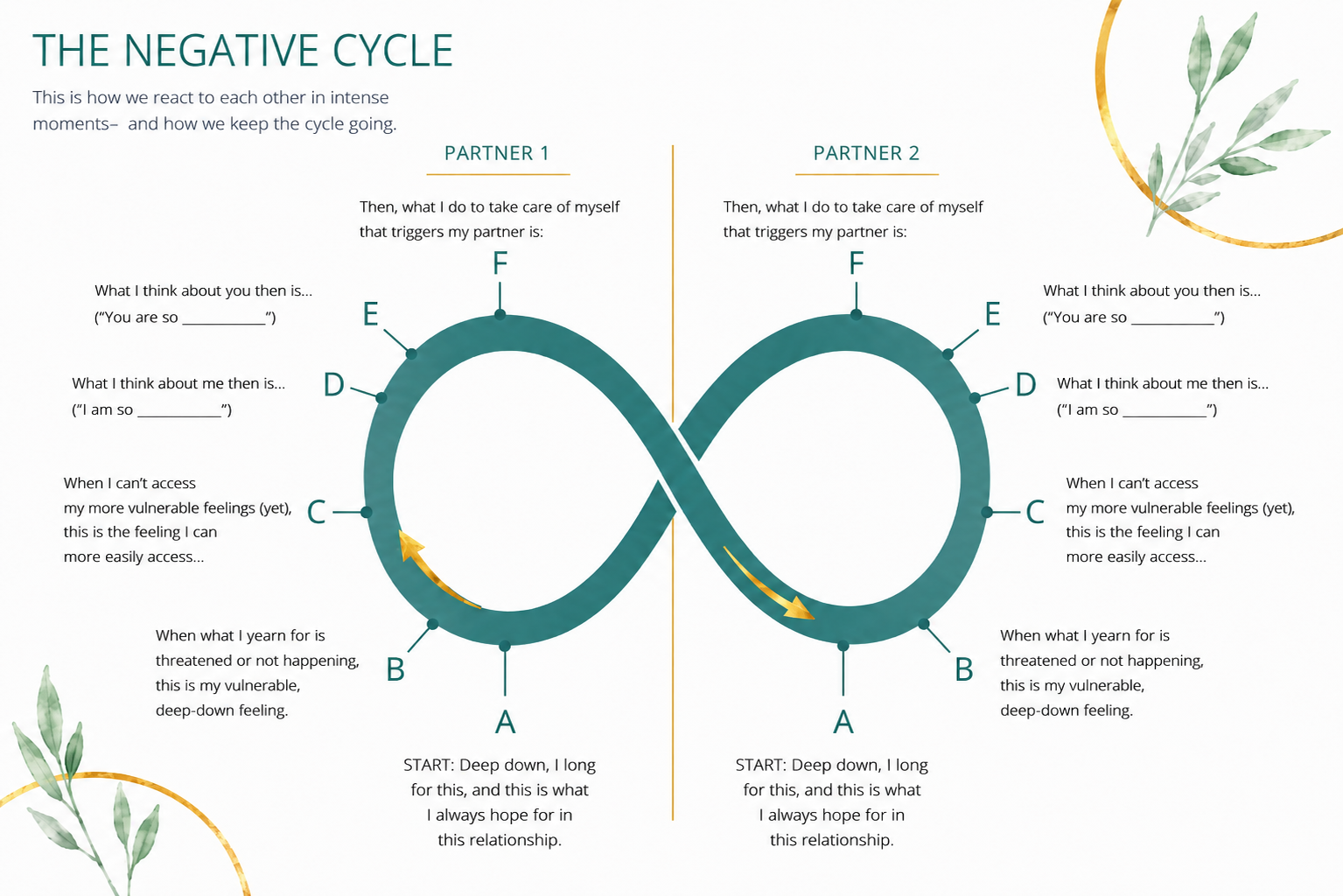
Why we get stuck in the same fight, and how to start seeing how we affect each other when we try our best
Most people don’t get stuck because they don’t love each other enough.
They get stuck because in painful moments, both people start protecting themselves and the relationship in ways that make the most sense to them, and with that, sometimes accidentally hurt the other person.
For instance, Blake feels sad because Charlie comes home late for the third time this month. Blake thinks that if they can only get Charlie to see what they did wrong, they can repair. However, Charlie feels criticized and goes silent. Blake feels more lonely and tries to get through by becoming even louder, after which Charlie’s sense that they did something wrong increases, and they put an even higher wall up. The more Charlie retreats, the lonelier Blake feels and the more critical they get, the more Charlie retreats even more. Round and round they go.
If we look at the fights people have with their loved ones, the content might be different, but the underlying pattern often repeats itself. This is because we’ve learned from our childhood or past relationships how to deal with specific emotions. Because fights with our loved one codes in our system as mortal danger, it’s easy for our wired conditioning to get triggered, and we respond from our fight/flight/freeze/fawn response.
In some households anger was predominant, and we might’ve learned that we have to be assertive in order to be heard. In another we’ve seen our mother always sacrifice herself, and somehow we’ve encoded in ourselves to always put others’ needs above our own. And then when we have a fight with our beloved one(s), this old coding gets activated and it’s difficult to not act instinctively. Tragically, the way we respond might trigger our partner’s deeper fears, and then they respond from their old coding. We end up feeling alone and separated, when we want nothing more than to be understood and feel connected. Perhaps the most baffling thing in this all, is that we all truly do our best to protect the relationship (and ourselves) according to what we know. Nobody thinks: I’m going to create a rupture for fun. We think: I just really need you to see this, or: I don’t want to make things worse so that’s why I put walls up, or… it’s really all good intentions. And it’s tragic when it inadvertently keeps us from what we want most: connection to the person who matters so much.
Understanding how we accidentally keep this negative cycle alive helps us in slowing it down, and eventually stopping it. This might not happen in one go. Sometimes it takes a while for us to even understand what happened. Or even while we intellectually understand, our emotions might be too strong in the moment to stop ourselves from our conditioned reactions. This is perfectly human. But the more we practice, the more we’re able to take the power away from the negative cycle. Maybe at first it’ll take a week before we’ve cooled down enough to reflect on what happened. The next time, it’ll take a day. And then one day, we’ll be able to say in the moment as we’re fighting: “Hey, we’re doing that thing again. How about we slow down together?” With repeated experience, mutual safety, we can create a new path. I often compare it to forging a new path through a corn field or forest. Our old pattern is a concrete highway. It’s so easy to go there because we’ve gone there many times. It’s okay it takes time to learn a new way. But the more we do so, the more this new road becomes accessible. And this path can be filled with flowers and greenery on the side of the road.
Once you can see the cycle together, you no longer have to experience each other as the enemy during fights. The cycle becomes the shared opponent. But how can we start to map this loop? In therapy I’ll support you with this, and at home you can continue to map together.
Identifying the negative cycle: an exercise.
Before you start
It’s a good starting point to use one concrete, recent situation that is rather typical in your relationship. Don’t worry about getting it exactly right or representative. You can keep coming back to this after a disagreement and explore again together: what actually happened there?
Start gently. You do not have to reach the deepest layer immediately. Sometimes “I don’t know yet, but I notice tension” is already a perfectly good beginning.
Fill in your own side first. Then look together at how one side affects the other.
If there is violence, threat, coercion, serious addiction, or active unsafety, do not do this exercise together at home. This belongs in a safe therapeutic setting.
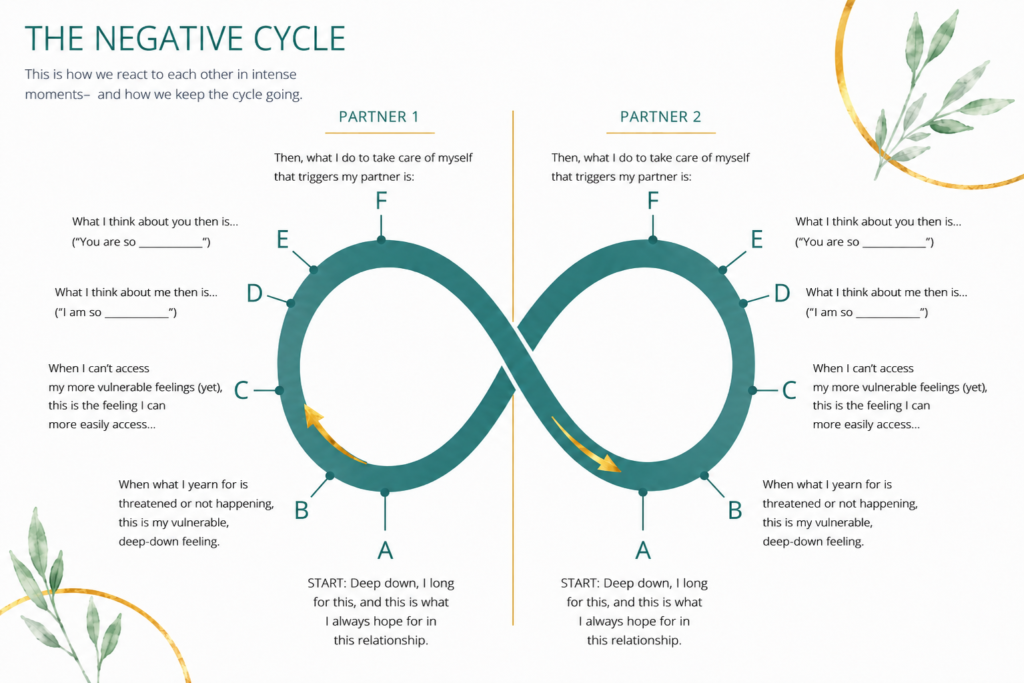
The six layers of the cycle
| Letter | Layer | What you explore | Sentence starter |
|---|---|---|---|
| A. | Deep longing / attachment need | What do you deeply want to feel in this relationship? E.g. Loved, important, chosen, safe, free, close, understood, welcome. | “I long to feel … with you.” |
| B. | Vulnerable (primary) feelings | What do you feel underneath the surface when that longing is at risk or seems unavailable? It is usually more difficult to feel these feelings, because they’re often underneath the reactive feelings. E.g. alone, scared, small, not chosen, sad, powerless, ashamed, rejected, unimportant, empty, lost, unwelcome | “Underneath my anger/distance/annoyance, I feel …” |
| C. | Reactive or protective (secondary) feelings | What is the feeling you usually feel first or most easily? This is often what your partner sees first: e.g. anger, irritation coldness, panic, numbness, hardness, the need to control, pure logic. | “What you usually see is that I become …” |
| D. | Thoughts about myself | What do you start telling yourself, about yourself? E.g.: I am being treated unfairly, I shouldn’t give in, I am too much, not important, alone, difficult, powerless, rejected. | “In that moment, I think about myself: I am …” |
| E. | Thoughts about my partner | What do you start thinking about your partner? E.g.: You’re overreacting, you are angry, you don’t see me, you don’t care, you attack me, you always withdraw, you’re never satisfied. | “In that moment, the story that comes up for me about you is…” |
| F. | Protective actions / outside behaviour | What do you do to protect yourself? E.g. Push, explain, go silent, withdraw, please, control, criticize, joke, leave, shut down, become hyper rational, try to find solutions. | “What I do to protect myself is …” |
Important to take into consideration
This whole exercise is an exercise in vulnerability.
However, sharing thoughts that come up about yourself and about the other can be especially triggering. It helps when we slow down and consider that:
- The meaning we make about another person isn’t always true. For instance, when we see a grimace on our beloved’s face, we can easily tell ourselves they’re angry. However, they might actually feel scared, stressed, unsure, or something else. When we’re triggered, our brains scan for danger. We can easily overinterpret signals we see. This is extra challenging amongst couples, because couples usually do read each other very well. You get attuned to your partner’s every cue, notice they behave differently very quickly. But a frown doesn’t always mean what you think it means. Keep space in your mind to be curious about your partner’s experience, instead of letting your own fear fill in their truth.
Nobel prize winner and physicist Niels Bohr said: ‘You can recognize a small truth because its opposite is a falsehood. The opposite of a great truth is another truth.’ The same is true in relationships. Rather than right or wrong, looking for ‘what is your experience’, is much more connective and illuminating. And often, letting in your partner’s truth and understanding their motivations is a relief, because our brains usually fill in the blanks with our worst fears. And mind you, this does not exempt someone from acknowledging the impact they’ve had on you, or the hurt they’ve caused, accidentally or not. - So when you share thoughts about your partner, it really helps if you are both aware that this is just a story that comes up, likely highlighting underlying needs.
- The same is true for thoughts about ourselves.
We can tell ourselves the most painful things about ourselves. On the surface, these thoughts might sound like: ‘I’m being treated unfairly’, ‘I shouldn’t give in’… but deeper down, they can sound like: ‘I’m too much, I’m all alone again, I’m a bad person’. When we practice taking a little bit of distance from our thoughts when they arise, we might see they’re not necessarily true. We might start to get curious about why these thoughts come up. They’re often old stories, maybe they even used to serve us in some way. Maybe some of them still do, but they might be a little bit too loud or alert.
How to talk about this together
Try to do this when you have the emotional bandwidth (not hungry, tired, etc.) , and when you notice you get triggered, just agree to take a pause. Again, this is vulnerable stuff. It’s okay that it might take some attempts.
Read your own A (what you long for) and B (more vulnerable emotions) first, before moving to C–F. The softer layers often make it easier for your partner to listen.
After one partner shares, the listening partner first reflects what they heard. Try to really take in what your partner is saying.
Then look together for the cycle sentence:
“The more I …, the more you …, and then I feel …, which makes me … even more.”
Examples:
“The more I push, the more you shut down; and the more you shut down, the more alone I feel, so I push harder.”
“The more I go quiet, the more anxious you become; and the more anxious you become, the more I feel I’m failing, so I go even quieter.”
Once you identified the loop, it helps to give it a name. Some people might call it: the Blame-Withdraw Debacle, the Wild West Shootdown, the Who’s Right Nobody Wins… feel free to get creative with it.
The next time you’re caught in a fight, naming it helps taming it.
If you want to do this exercise, here’s a printable version:
En een printbare versie van de oefening in het Nederlands: